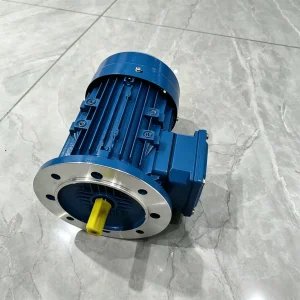
In low-speed heavy-load scenarios in industrial production, such as conveyors, mixers, and crushers, the stability of the electric motor’s power output, overload resistance, and operating efficiency directly determine the continuity and economy of production. The YE3-132S-6 3kW electric motor, an three phase asynchronous motor specifically designed for low-to-medium speed operating conditions, is a preferred choice for such scenarios due to its advantages of a rated speed of 970 r/min, high stall torque, and compact structure. This article provides a comprehensive guide for practical operation from three aspects: scenario adaptability analysis, core parameter adjustment methods, and application precautions.
The scenario adaptability of the YE3-132S-6 3kW electric motor stems from its unique design characteristics. This motor adopts a 6-pole winding design with a rated speed of only 970 r/min, directly matching the speed requirements of most low-speed equipment without the need for an additional reduction gear mechanism, reducing transmission losses and equipment maintenance costs. In terms of heavy-load performance, its rated torque reaches 29.8 N·m, and its stall torque multiple is ≥2.0, easily handling the large load impact during equipment startup and avoiding startup jamming issues. Simultaneously, the motor’s protection rating reaches IP54, and its insulation class is F, making it suitable for industrial environments with high dust and humidity, and applicable to various low-speed, heavy-load fields such as mining conveying, building material mixing, and food processing.
For the specific needs of low-speed, heavy-load scenarios, proper adjustment of motor parameters is crucial to ensuring operational stability. The core adjustment parameters mainly include the V/F curve, starting parameters, and overload protection thresholds. Regarding V/F curve adjustment, a “low-frequency boost” strategy should be adopted for low-speed, heavy-load applications. This involves appropriately boosting the voltage in the frequency band below 5Hz using the frequency converter to compensate for insufficient torque caused by the stator resistance voltage drop. Typically, the voltage corresponding to 5Hz is increased from 10% to 15%-20% of the rated voltage to ensure the motor can still output sufficient torque at low speeds.
Starting parameter adjustment must balance starting torque and current surge. It is recommended to use torque-limited starting in vector control mode, setting the starting torque to 1.5-2.0 times the rated torque and extending the starting time to 10-15 seconds. This avoids grid fluctuations caused by excessive starting current and prevents the motor from failing to drive the load due to insufficient torque. Overload protection threshold adjustments should be based on actual load characteristics. Low-speed, heavy-load equipment often experiences short-term overload conditions. The overload protection action value can be set to 1.2-1.5 times the rated current, with an action time of 60-90 seconds. This avoids long-term overload damage to the motor while preventing false triggering of protection due to momentary overload.
In addition, two key points should be noted during application. First, heat dissipation protection: At low speeds, the motor fan’s cooling efficiency decreases, easily leading to excessive temperature rise. It is recommended to install an independent forced cooling fan for the motor or adopt the inverter’s “frequency reduction and load reduction” strategy. When the speed is below 500 r/min, appropriately reduce the output power to control the motor temperature rise to no more than 80℃. Secondly, regular maintenance is essential. Monthly checks of motor bearing lubrication and quarterly winding insulation resistance tests are necessary to ensure the motor’s lifespan under heavy load conditions.
In summary, the YE3-132S-6 3kW electric motor offers significant advantages in low-speed, heavy-load scenarios. By scientifically adjusting the V/F curve, starting parameters, and overload protection thresholds, along with comprehensive heat dissipation and maintenance measures, its torque advantage can be fully utilized to ensure stable and efficient production. In practice, parameters must be precisely adjusted based on the specific equipment load characteristics to achieve the optimal match between motor performance and operating conditions.